
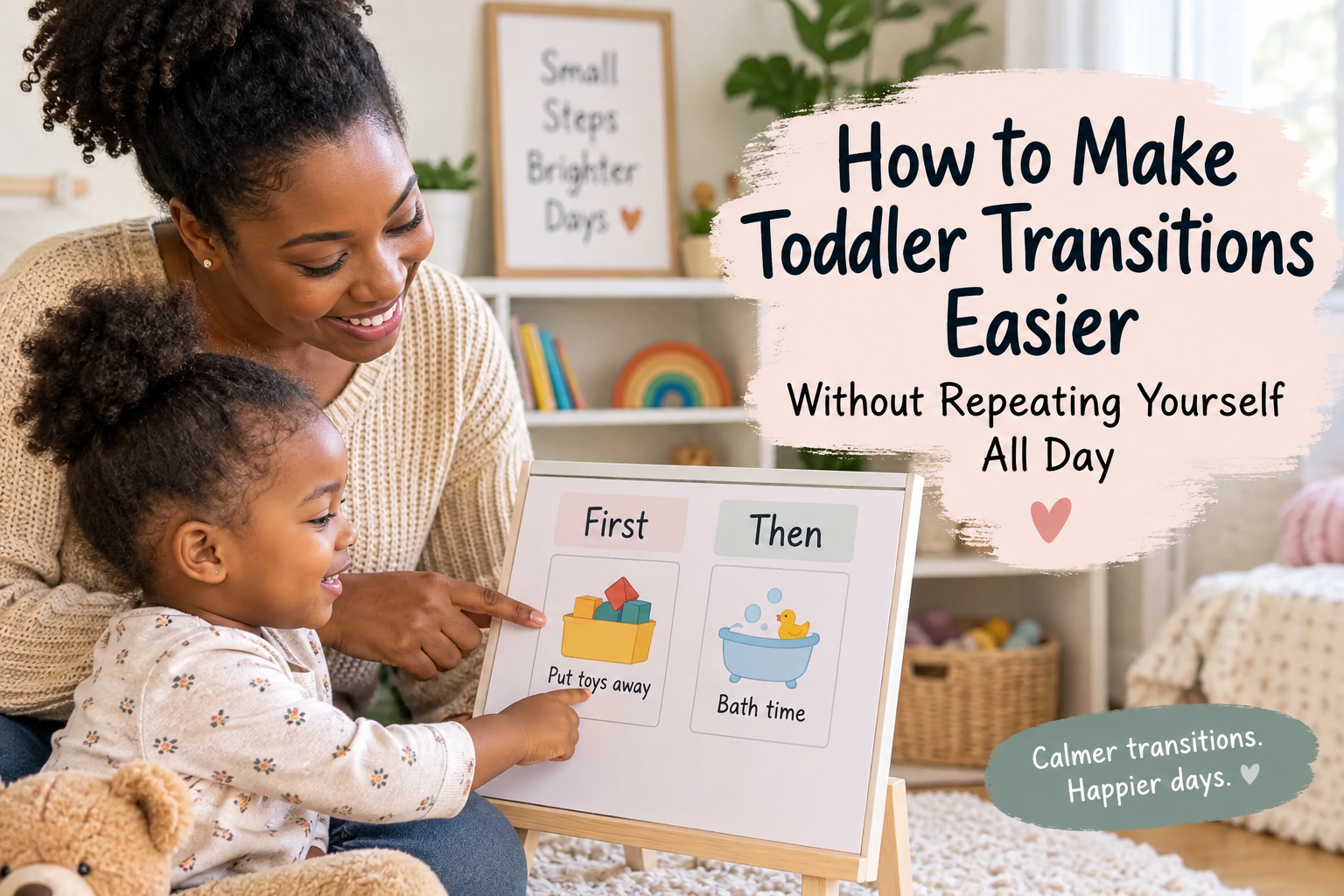
You have asked your toddler to put the toys away.
Nothing happens.
You ask again.
“Sweetheart, we’re going to have a bath now.”
Still playing.
You give another reminder.
Then you finally switch off the television, take away the toy or announce that playtime is over.
And suddenly, everything falls apart.
Crying.
Running away.
“No!”
“I’m not finished!”
Maybe even a full meltdown over something that, from an adult’s point of view, happens every single day.
If this happens regularly in your home, your toddler may not necessarily have a problem with the activity you are asking them to do.
The difficult part may be the transition.
A transition is simply the movement from one activity, place or part of the day to another.
Playing → bath time.
Breakfast → getting dressed.
Home → preschool.
Screen time → dinner.
Park → home.
Story time → bed.
Adults make dozens of these shifts every day without thinking much about them.
For toddlers, stopping something they are enjoying and moving into something they did not choose can be much harder.
The solution is not to repeat yourself twenty times.
Instead, you can make the transition more predictable, visible and manageable.
Why Do Toddlers Struggle With Transitions?
Imagine you are deeply focused on something you enjoy.
Someone suddenly walks in, turns it off and says:
“We are leaving. Now.”
You might understand why you need to leave, but you probably would not appreciate the abrupt interruption.
A toddler has an additional challenge: young children are still learning how routines work, how to regulate strong emotions and how to move their attention from one activity to another.
Predictability can help.
The Centers for Disease Control and Prevention explains that routines help children know what to expect and recommends consistency, predictability and follow-through when creating structure for young children.¹
ZERO TO THREE similarly recommends letting toddlers know when a transition is approaching because advance notice can help them prepare for the change.²
That does not mean a toddler will happily cooperate every time.
The goal is not to eliminate every protest.
The goal is to make the change less surprising and easier to understand.
Stop Expecting “We’re Leaving” to Do All the Work
One of the biggest problems with transitions is that adults sometimes give the child information only when the transition is already happening.
“Okay, let’s go.”
“Turn that off.”
“Bath time.”
“Come inside.”
From the parent’s perspective, this may be completely reasonable.
From the child’s perspective, the activity they were enjoying has suddenly ended.
Try separating the warning from the instruction.
Before it is time to leave the playground, you might say:
“We’re going home soon. You have a little more time to play.”
Then remind them again shortly before leaving.
Finally:
“It is time to go home now.”
ZERO TO THREE specifically suggests giving young children advance notice before a transition, including reminders as the change gets closer.³
The warning does not mean negotiating endlessly.
You are simply helping your child understand that the current activity is approaching its end.
Make “What Happens Next” Visible
Some toddlers respond well to spoken reminders.
Others benefit from seeing what is coming.
A visual routine can turn an abstract instruction into something much more concrete.
Instead of repeatedly saying:
“After breakfast we’re going to get dressed, then brush your teeth, then put on your shoes because we need to leave…”
your child can see:
Breakfast → Get Dressed → Brush Teeth → Shoes
The CDC provides visual schedules as one strategy for helping young children understand what is coming next during the day.⁴
A visual routine is particularly useful when the same transitions happen repeatedly.
Morning routine.
Getting ready for preschool.
Leaving the house.
Bath time.
Bedtime.
You do not need a picture for every minute of the day.
Start with the part of the day where your child needs the most support.
Try “First, Then” for Difficult Transitions
Some transitions do not need an entire routine chart.
They need two steps.
That is where First → Then can be useful.
For example:
First: Put toys away Then: Bath
Or:
First: Shoes on Then: Outside
Or:
First: Brush teeth Then: Story
Your toddler can see that the less-preferred activity is not the entire future.
Something familiar or enjoyable follows it.
Be careful, however, not to turn every normal responsibility into a prize negotiation.
“Then” does not always have to mean sweets, toys or screen time.
It can simply show the natural next part of the routine.
First pajamas, then story.
Both activities were already going to happen.
You are simply making the order clear.
Use “Now, Next, Later” When Two Steps Aren’t Enough
Some toddlers are ready for slightly more information.
You can expand the idea into:
Now → Next → Later
For example:
NOW: Eat breakfast NEXT: Get dressed LATER: Go to Grandma’s house
This can be especially useful when your child keeps asking about something they are excited about.
“Are we going now?”
“Now?”
“Is it time yet?”
Instead of explaining the whole day’s schedule repeatedly, you can point to the sequence.
Right now we are eating.
Next we get dressed.
Later we go.
Your toddler doesn’t need to understand clock time to know the exciting activity is coming.
Give Choices But Only Real Choices
Another useful transition strategy is offering a little control.
Toddlers are developing independence.
Sometimes the fight is not really about putting on pyjamas.
It is about having no say in what is happening.
You can keep the boundary while offering a choice inside it.
Instead of:
“Do you want to have a bath?”
when bath time is not actually optional, try:
“It is bath time. Do you want the duck or the boat?”
Instead of:
“Do you want to get dressed?”
try:
“Would you like the blue shirt or the green shirt?”
ZERO TO THREE recommends offering young children age-appropriate choices while avoiding questions when there is no actual choice.⁵
The important distinction is this:
The parent controls the boundary. The toddler gets an appropriate choice within the boundary.
That gives the child some agency without handing over decisions they are not responsible for making.
Stop Giving Five Instructions at Once
Consider this instruction:
“Put your toys away, go and get your pajamas, use the potty, wash your hands and come brush your teeth.”
That’s a lot.
Even adults sometimes forget the third thing on a long verbal list.
With a toddler, simplify.
Start with:
“Let’s put the toys away.”
When that is complete, move to the next step.
Or use the visual sequence so the child does not have to hold everything in mind at once.
The aim is not to see how many instructions your toddler can remember.
The aim is to help them successfully move through the routine.
Create a Transition Ritual
Not every transition needs a board.
Sometimes a small repeated ritual becomes the cue.
For example, cleanup might always begin with the same cleanup song.
Bedtime might begin when you dim the lights and choose pajamas.
Leaving the park might include saying, “Goodbye swings. Goodbye slide. We’ll come back another day.”
Going to preschool might follow the same goodbye routine each morning.
ZERO TO THREE notes that songs, books, games and familiar rituals can help children move from one part of the day to another.⁶
The exact ritual matters less than the repetition.
Over time, the cue begins to mean:
This activity is finishing. Something else is beginning.
Acknowledge the Feeling Without Changing Every Boundary
You can understand your toddler’s disappointment without reversing every decision.
Imagine your child is crying because playground time is over.
You can say:
“You really wanted to keep playing. You had fun here.”
And still leave.
Or:
“You don’t want to turn the television off. I know. Screen time is finished.”
A child’s feelings do not automatically mean the boundary was wrong.
This distinction matters.
Sometimes parents become trapped in endless explanation because they are trying to make the toddler agree with the transition before continuing.
Agreement is not always necessary.
Your toddler can be unhappy about bedtime and still go to bed.
They can want another cartoon and still have screen time end.
They can dislike leaving the playground and still leave.
Your job is to make the transition understandable, keep the boundary reasonable and help them through the emotion.
What If the Toddler Still Has a Meltdown?
Then the strategy did not necessarily fail.
A warning does not guarantee cooperation.
A visual card does not guarantee zero tears.
A First → Then board does not eliminate frustration.
These tools help create predictability.
They do not remove toddlerhood.
If your child becomes overwhelmed, reduce the amount of talking.
When emotions are very high, a long lecture usually adds more information when the child is already struggling.
Keep your language simple.
“You’re upset.”
“We are going home.”
“I’ll help you.”
Then deal with the teaching later, when everyone is calmer.
Look for Patterns Before Blaming Behaviour
If the same transition goes badly every day, stop treating every episode as a completely new behaviour problem.
Look at the pattern.
Does your toddler struggle most when they are hungry?
When they are tired?
When screen time ends?
When they have to stop an activity without warning?
When the morning routine feels rushed?
When they do not know where they are going?
When too many instructions arrive at once?
The repeated problem gives you information.
For example, if getting dressed becomes a battle every morning, you might prepare two clothing choices the night before and place “get dressed” on the visual morning routine.
If leaving for preschool causes problems, you might use:
Breakfast → Clothes → Teeth → Shoes → Preschool
If bedtime becomes chaotic after screen time, you might consider changing the sequence so there is a calmer transition between the two.
Do not just ask:
“Why is my toddler being difficult?”
Ask:
“What exactly happens before this becomes difficult?”
That question gives you something you can change.
Don’t Change Five Things at Once
When daily transitions are frustrating, it is tempting to create an entirely new household system.
Do not.
Choose one transition.
Maybe it is:
Leaving the house in the morning.
Turning off screens.
Cleaning up toys.
Bath time.
Or bedtime.
Choose one tool.
Maybe:
An advance warning.
A First → Then board.
A visual routine.
A simple choice.
Or a transition song.
Try it consistently.
Observe what changes.
Then adjust.
A system that your family actually uses is more valuable than a beautiful routine chart that becomes another forgotten item on the wall.
When a Visual Toolkit Can Help
You can create visual routine cards yourself with paper, drawings or photographs.
But if you would rather start with a ready-made system, Little Steps — Toddler Routine & Independence Toolkit was created to help parents make everyday routines and transitions more visible without having to design everything from scratch.
The toolkit includes visual routine cards and flexible boards that can be used for everyday sequences, First → Then, Now → Next → Later, To Do → Done, choices, calm-down support and other common toddler routines.
You do not need to use every card.
Choose the part of the day where your toddler needs the most support and build from there.
You Should Not Have to Repeat Yourself All Day
Toddlers will still need reminders.
They are learning.
But there is a difference between normal repetition and becoming the household announcement system:
“Get dressed.”
“Get dressed.”
“Didn’t I tell you to get dressed?”
“Where are your shoes?”
“Come back.”
“Shoes.”
“Shoes!”
When the routine exists only inside your head, you have to keep communicating it.
When some of that routine becomes visible and predictable, your child has another source of information.
So start small.
Prepare them before a change.
Show them what comes next.
Offer a small choice where appropriate.
Use simple routines repeatedly.
And remember: success does not mean your toddler happily agrees with every transition.
Sometimes success simply looks like your child beginning to understand:
This is what we’re doing now. This is what comes next. And I know what to expect.
Frequently Asked Questions
Why does my toddler cry every time we change activities?
Toddlers can find transitions difficult because they are stopping one activity and shifting their attention to another, often without having chosen the change themselves. Making transitions predictable through routines, advance warnings and simple visual cues can help some children prepare for what is coming.
How much warning should I give before a transition?
There is no single perfect amount of time for every toddler. The purpose of the warning is to signal that the activity will end soon. You can give an initial warning and another short reminder as the transition gets closer. Keep the wording simple and follow through when the time comes.
What is a First-Then board?
A First-Then board shows two activities in order: what your child needs to do first and what happens immediately afterward. For example, “First brush teeth, then story.” It makes the sequence visible without showing an entire daily schedule.
Should I give my toddler choices during transitions?
Small, genuine choices can give toddlers appropriate control. For example, your child might choose which shirt to wear while getting dressed itself remains the expectation. Avoid presenting something as optional when it is not actually optional.
Do visual schedules work immediately?
Not necessarily. Children need to learn what the pictures mean and how the system works. At first, you may need to point to each picture, name the activity and move through the sequence together.