
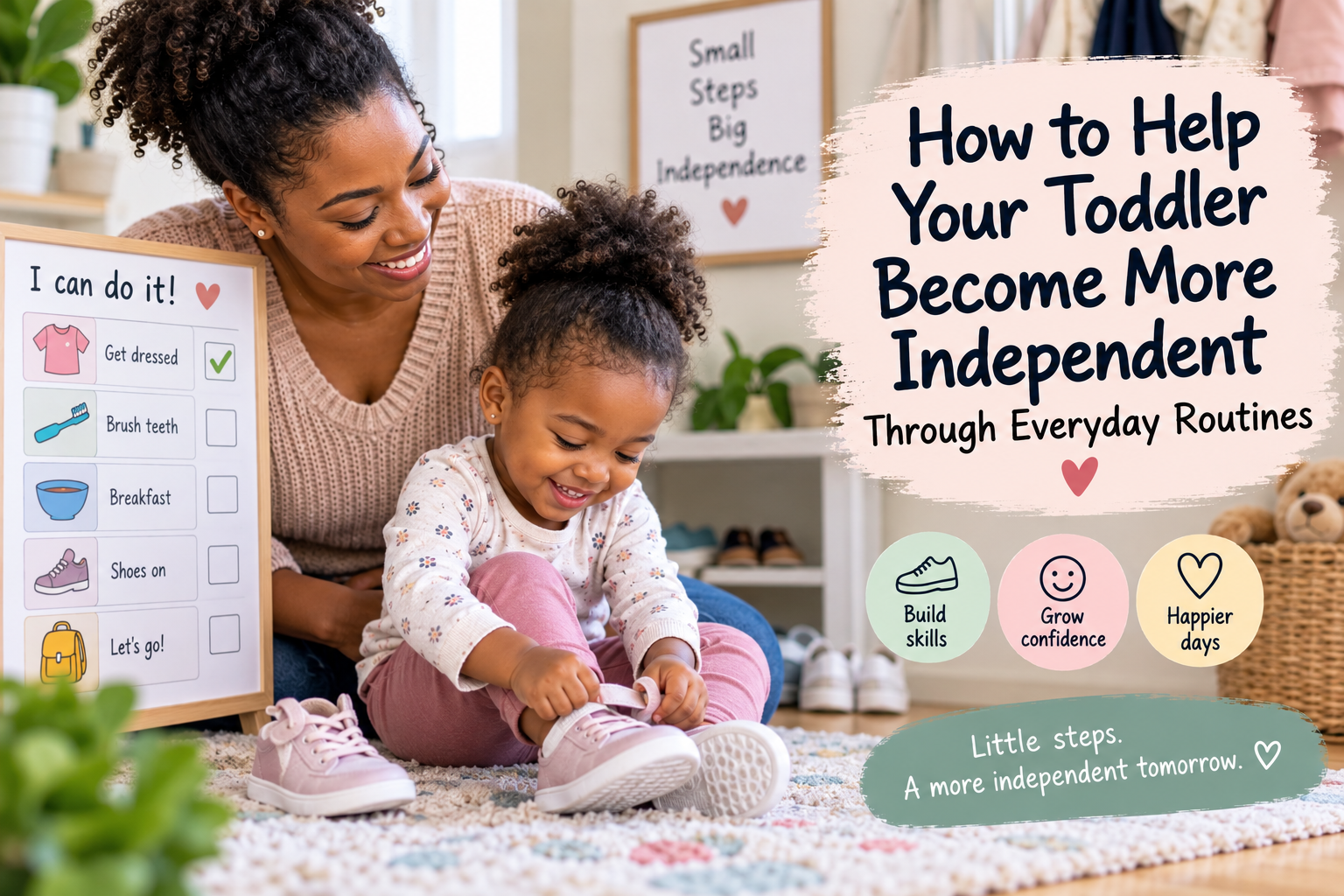
“I do it!”
If you live with a toddler, you have probably heard some version of that sentence.
You try to put on their shoes.
“I do it!”
You reach for the spoon.
“No! Me!”
You try to help with the zip.
“I can do it!”
Then five minutes later, the same child who insisted on doing everything alone is asking you to carry them.
Welcome to toddler independence.
It can look contradictory, messy and painfully slow when you are trying to leave the house.
But that desire to participate is something we can work with.
Helping a toddler become more independent does not mean expecting them to manage themselves like a much older child.
It means gradually giving them appropriate opportunities to participate in everyday life while you continue providing the structure, help and safety they need.
And you do not need a special “independence lesson” to do it.
Some of the best opportunities are already happening every day:
Getting dressed.
Eating.
Cleaning up.
Getting ready to leave.
Bath time.
Bedtime.
The routines you are already doing can become practice grounds for independence.
Independence Starts With Participation
Sometimes adults think of independence as:
“My child can do this completely alone.”
That is a very high standard for a toddler.
A better starting point is:
“What part of this can my child participate in?”
Your toddler might not be able to dress themselves completely.
But perhaps they can choose between two shirts.
They might push one arm through the sleeve.
They might pull up their trousers after you help position them.
They might carry their dirty clothes to the laundry basket.
That is still independence developing.
The CDC encourages parents of young toddlers to support growing independence by allowing children to help with everyday activities such as dressing and feeding themselves.¹
The goal is not immediate mastery.
It is practice.
Stop Doing Everything Just Because It Is Faster
This is one of the hardest parts.
Adults are efficient.
Toddlers are not.
You can put your child’s shoes on in 20 seconds.
Your toddler may take several minutes to get one foot halfway inside the wrong shoe.
You can carry the plate to the kitchen without spilling anything.
Your toddler may walk at the speed of a snail while watching the cup wobble.
So when you are tired, late or busy, it is understandable to think:
“Please. Let me just do it.”
Sometimes you genuinely need to.
But if we always step in because we can do something faster, the child gets fewer opportunities to practise.
You do not have to turn every rushed morning into a learning session.
Instead, look for moments when you have enough time to let your toddler try.
Maybe weekend mornings are better for practising dressing.
Maybe after dinner they can carry an unbreakable cup to the kitchen.
Maybe before bath time they can put their clothes into the laundry basket.
Small opportunities repeated regularly matter more than forcing independence during every routine.
Give Them Jobs That Are Actually Toddler-Sized
Independence grows more easily when the task matches the child’s abilities.
“Clean your entire room” is vague and overwhelming.
“Put the blocks in this basket” is concrete.
“Get yourself completely ready” involves many steps.
“Put your shoes beside the door” is much clearer.
Young children often need tasks broken into manageable actions.
Instead of expecting the finished adult version of a task, identify one part they can handle.
During cleanup, your toddler might put books on a shelf.
During mealtime, they might carry their plastic plate.
During dressing, they might choose the shirt.
During bedtime, they might choose the book.
During the morning routine, they might move each completed routine card to Done.
These jobs may look small to us.
But to a toddler, they communicate:
I am part of what happens here.
Use Routines to Create Repetition
Toddlers learn through repetition.
That is one reason everyday routines are so useful.
You do not need to invent twenty new activities.
If your toddler puts their pajamas in the laundry basket every morning, they get repeated practice.
If they move their toothbrush card to “Done” every night, they learn the sequence.
If they put their shoes beside the door after coming home, that action starts becoming familiar.
The CDC recommends steady routines for activities such as eating and sleeping and provides daily schedules as a tool for helping young children know what to expect.²
Predictable routines do more than organise the day.
They create repeated opportunities for a child to practise the same skills.
Let Them Make Small Decisions
Independence is not only physical.
It also involves learning to make simple decisions.
For young toddlers, the CDC recommends offering simple choices between two options.³
That might look like:
“Blue shirt or yellow shirt?”
“Apple or banana?”
“Duck or boat for the bath?”
“This book or this book?”
Notice that you have already decided the bigger issue.
Your child needs clothes.
They are having a snack.
It is bath time.
You are reading one bedtime story.
You are not handing over responsibility for the whole day.
You are allowing them to practise choosing inside a safe boundary.
That is very different from:
“What do you want to do today?”
when every answer could potentially become a negotiation.
Let the Environment Do Some of the Work
Sometimes we tell toddlers to be independent while arranging the environment so they need an adult for everything.
Their shoes are out of reach.
Their clothes are stored too high.
Their routine chart is at adult eye level.
The toy basket is difficult to open.
Their cup is somewhere they cannot reach safely.
You do not need to redesign your whole home.
But look at the routines where you want greater participation and ask:
Can my child actually access what they need?
Perhaps the everyday shoes can stay on a low shelf.
Perhaps two clothing options can be placed where the child can see them.
Perhaps the routine board can be positioned at their height.
Perhaps toys can go into simple open baskets rather than complicated storage.
A supportive environment does not mean giving toddlers unrestricted access to everything.
Safety still comes first.
It simply means making appropriate tasks easier for them to attempt.
Use Visual Routines Instead of Becoming the Reminder Machine
Imagine every morning sounds like:
“Get dressed.”
“Brush your teeth.”
“Come back.”
“Where are your shoes?”
“Get your bag.”
“Shoes!”
“Come on!”
When every step exists only inside the parent’s head, the parent has to keep supplying the information.
A visual routine can help move some of that information outside your head.
Your toddler might see:
Get dressed → Brush teeth → Breakfast → Shoes → Leave
At first, you still guide them.
You point to the card.
“What’s next?”
“Brush teeth.”
After brushing:
“Done. Move it over.”
Over time, the routine may become more familiar.
Instead of always telling your child the next step, you can sometimes ask:
“What comes next?”
That is a small shift, but it matters.
The CDC notes that pictures and visual cues can be useful reminders for toddlers and preschoolers who cannot yet read.⁴
The visual does not replace the parent.
It gives the child another way to participate.
Try “To Do → Done”
One of the simplest ways to involve a toddler in a routine is letting them see progress.
Imagine three morning cards:
Get dressed
Brush teeth
Shoes
They begin on the To Do side.
After getting dressed, your child moves that card to Done.
After brushing teeth, another moves.
Then shoes.
Instead of the routine feeling like an endless list of adult demands, your toddler can see tasks disappearing.
It creates a beginning, progress and an end.
For some children, physically moving the card is also a small responsibility they can own.
Do Not Correct Every Imperfection
Your toddler folds the washcloth badly.
The shoes are slightly crooked beside the door.
They put the book on the wrong shelf.
They tried to pull up their trousers, but the waistband is twisted.
There is a strong adult temptation to immediately redo everything.
Sometimes correction is necessary, especially when safety or hygiene matters.
But not every imperfect attempt needs to be replaced by the adult version.
If the toddler puts the toys in the basket but they are not arranged beautifully, the task may still be complete.
If you redo everything in front of them, the message can accidentally become:
“Your attempt was not good enough. The adult needs to fix it.”
Where appropriate, acknowledge the effort first.
“You put all the blocks in the basket.”
“You carried your cup carefully.”
“You remembered to put your pajamas away.”
Specific encouragement tells your child what they successfully did.
The CDC recommends giving children attention and praise when they follow instructions and show positive behaviour.⁵
Help Without Taking Over
There is a useful middle ground between:
“You must do it completely alone.”
and:
“Move, I’ll do everything.”
Suppose your toddler wants to zip their jacket but cannot connect the bottom of the zip.
You can start the zip.
Then let them pull it upward.
If they cannot put their shoes on, you can position the shoes correctly and let them push their feet inside.
If they are learning to clean up, you might pick up toys together instead of doing the entire room yourself.
Think:
What is the smallest amount of help that allows my child to keep participating?
That can be more useful than either abandoning them to frustration or immediately taking over.
Allow Enough Time for Practice
Independence and rushing are terrible partners.
If you need to leave the house in three minutes, that may not be the best moment to teach your toddler how to put on shoes independently.
You already know what will happen.
You will become frustrated.
They will become frustrated.
You will eventually put the shoes on yourself.
Choose your practice moments strategically.
If mornings are rushed, practise the same dressing skills later in the day.
If bedtime is already difficult, do not introduce five new responsibilities on the same night.
Build one skill.
Let it become familiar.
Then add another.
Do Not Confuse Independence With Lack of Supervision
Toddlers becoming more capable does not mean they need less protection from hazards.
Independence always operates within age-appropriate safety limits.
A toddler can choose which shirt to wear.
They do not choose whether to sit in the car seat.
A toddler can carry an unbreakable cup.
They do not carry a hot pot.
They can help wipe a table.
They do not handle cleaning chemicals.
They may want to climb independently.
That does not mean unsafe climbing becomes acceptable.
As young children become more independent, adult supervision and safety boundaries remain essential.⁶
Independence means:
“You can practise what you are ready to practise.”
Not:
“You are responsible for keeping yourself safe.”
What If My Toddler Says “I Can’t”?
Sometimes toddlers want independence.
Sometimes they suddenly decide they are incapable of everything.
You ask them to put the toy in the basket.
“I can’t.”
They have done it 40 times before.
Before jumping straight in, try reducing the task.
“Let’s do the first one together.”
Or:
“I’ll hold the basket. You put the blocks inside.”
Or:
“You do these two, and I’ll do these two.”
A little support may be enough to restart participation.
And sometimes the child genuinely is tired, overwhelmed or struggling.
Independence should not become a test they are punished for failing.
You are teaching a skill.
Skills develop over time.
Avoid Doing Too Much at Once
After reading about toddler independence, it can be tempting to decide:
“From tomorrow, my child will dress themselves, clean their room, clear the table, prepare their bag and manage their morning routine.”
That is too much.
Pick one routine.
Then choose one responsibility inside it.
For example:
Morning: choose between two shirts.
Or:
Bedtime: put pajamas in the laundry basket.
Or:
Cleanup: move books back to the shelf.
Once that action becomes familiar, add another.
You are building habits, not conducting an independence boot camp.
How Little Steps Can Support Independence
This is one of the reasons why I created Little Steps Toddler Routine & Independence Toolkit.
The goal is not to make toddlers manage themselves.
The goal is to give parents practical visual tools that can help children participate more actively in routines they are already learning.
The toolkit includes 44 visual routine cards and seven flexible visual boards, including:
First → Then
Now → Next → Later
To Do → Done
Choice supports.
Calm-down resources.
Encouragement cards.
Blank cards you can adapt to your family’s routines.
And a parent guide for introducing the system gradually.
You do not need to use everything.
Start with one routine.
Choose the cards your toddler needs.
Then let the visual system support the skills you are already practising together.
Independence Is Built in Small Moments
Helping your toddler become independent does not require making them grow up quickly.
It is almost the opposite.
You recognise what they can do right now, give them opportunities to practise it, and continue supporting what they cannot yet do.
It happens when they choose the shirt.
When they carry the cup.
When they try the shoe.
When they move the card to Done.
When they put one toy away.
When you resist taking over immediately.
Those moments look ordinary.
But repeated over months and years, they build something important:
A child who gradually learns,
I can try.
I can help.
I can make some choices.
I can learn new things.
And when I still need help, my parent is there.
That is toddler independence.
Not doing everything alone.
Learning, little by little, how to participate in their own life.
Frequently Asked Questions
What should a toddler be able to do independently?
There is wide variation between individual children. Rather than using another child’s abilities as your standard, look for safe, age-appropriate ways your child can participate in everyday activities. Depending on age and development, this might include helping with dressing, feeding themselves, carrying safe objects, making simple choices or helping with cleanup.
Should I let my toddler dress themselves?
You can allow them to participate according to their ability. A younger toddler might choose between two outfits or push an arm through a sleeve, while an older child may manage more of the process. Help where needed rather than expecting immediate independence.
How do I teach independence without creating power struggles?
Keep the adult boundary clear while offering appropriate participation. For example, you decide that it is time to get dressed, while your toddler chooses between two shirts.
What if helping themselves takes too long?
You do not have to practise every skill when you are rushed. Choose less pressured times for learning. On a busy morning, you may provide more help. At another time, allow more space for practice.
Can visual routines make toddlers more independent?
Visual routines can give children another source of information about what they are expected to do next. They will still need adult guidance, but familiar visual sequences can gradually support greater participation in everyday routines.
Should I reward my toddler every time they complete a task?
Not necessarily. Specific encouragement and recognition can be enough for many everyday tasks. You can tell your child exactly what they did successfully: “You put your shoes by the door” or “You carried your plate carefully.”